Why the lack of acceptance tests leads to time-consuming service calls
With 25 million “homes passed,” the expansion of fiber-optic networks in Germany has reached a scale where, in addition to civil engineering, right-of-way management, and new home connections, the focus is now primarily on operational reliability. But how can we permanently reduce the growing dissatisfaction among customers caused by reduced bandwidths or sporadic service interruptions?
According to the Gigabit Land Registry, by August 2025, over 50% of all households were already using or had arranged for a fiber-optic access. By early 2026, this amounted to approximately 14 million households within reach (Homes Connected), more than half of which were active (Homes Activated). In the next 12 months alone, an additional approximately 1.5 million households will be activated, and the trend is upward.
Technologically, GPON currently dominates with 2.5 Gbps downstream and 1.25 Gbps upstream, while XGS-PON, offering symmetrical 10 Gbps speeds, will be added in many locations as an upgrade over the same fiber.
As the number of activated accesses increases, more issues are emerging in the field: reduced bandwidth, sporadic disconnections, IPTV or OTT disruptions, VoIP problems, or customer complaints because the promised performance is not being delivered. Typical causes often lie in the last few meters: dirty connectors, faulty splices, excessive attenuation, incorrectly assigned PON branches, or misconfigured ONTs. Or an access that was never fully commissioned.
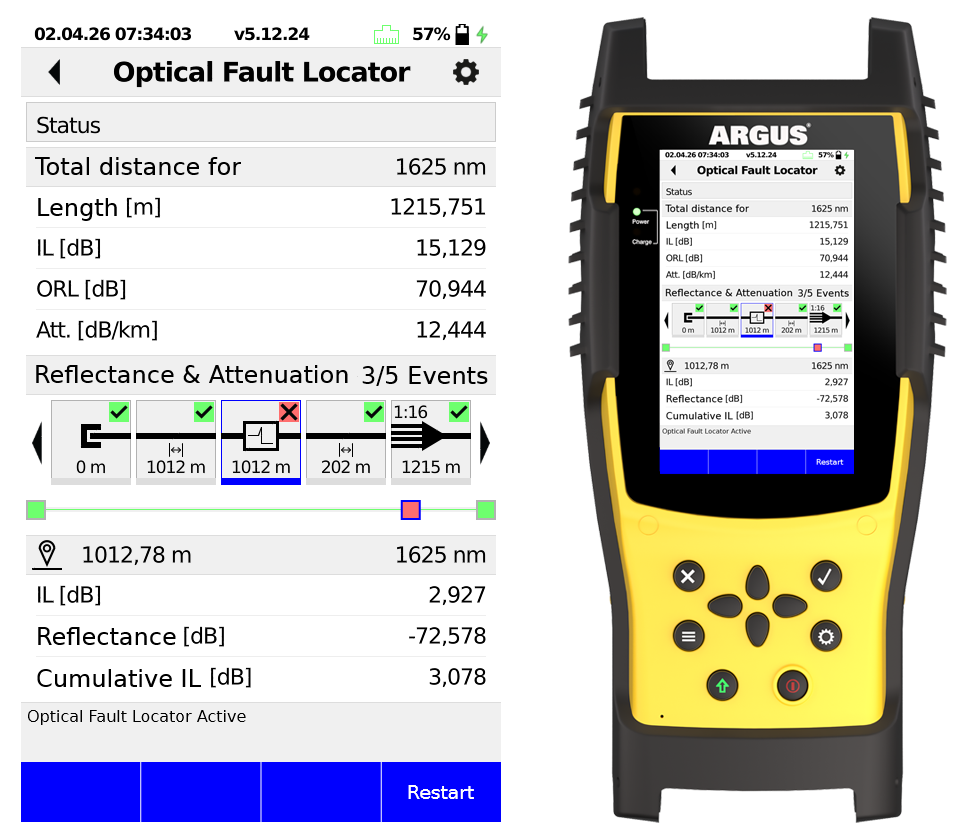
Optical Fault Locator in an ARGUS ® F240, capable of measuring and detecting faults up to the next 1:16 splitter. Measurements are taken at 1625 nm, a maintenance wavelength that can be used during live operation
Acceptance testing is crucial
In PON networks, simply verifying that there is “light on the fiber” is not sufficient during commissioning. An activated access is far from being a properly installed one. Anyone wishing to perform a reliable acceptance test today needs to know more than just the optical level.
First, let’s cover the basics: Are the fiber end faces clean? Are the optical levels correct? Is the technician on the right branch? Does the measured attenuation make sense? Are there any unusual events along the route? Is the service at the access performing as promised?In Germany in particular, with its many continuously spliced lines, long service drop chains, inconsistently documented distribution points, and coexisting GPON and XGS-PON structures, these issues are part of everyday practice. The acceptance test thus serves as the foundation for subsequent operation. Monitoring systems make problems visible, but they do not prevent them. The quality of an access is therefore determined during the acceptance test.
The defect is located on the end face of the fiber
Every fiber optic measurement begins at the fiber end face. Even the smallest particles or scratches in the core area can lead to significant signal loss. For this reason, test equipment should support fiber inspection. End faces can be inspected and evaluated using a video microscope. The cleanliness of the connector determines whether further measurements are reliable. A dirty end face distorts level readings and later leads to reflections, unnecessary attenuation, and troubleshooting. Documenting this condition as part of the acceptance test provides verifiable proof of quality, serves as a reference during subsequent operation, and reduces disputes in the event of a malfunction.
Selective OPM
The second step involves the optical evaluation of the active PON access. This is where the difference between a standard power meter and a meter designed for GPON and XGS-PON becomes apparent. In modern PON networks, multiple wavelengths are transmitted simultaneously over the same fiber. It is not sufficient to simply determine an overall level; what is crucial is the filtered measurement of the individual wavelengths. In the downstream direction, this applies in particular to 1,490 nm (GPON) and 1,577 nm (XGS-PON). In networks with video overlay, the 1,550 nm wavelength may also be relevant.
The upstream wavelengths of 1310 nm (GPON) and 1270 nm (XGS-PON) can only be measured under real operating conditions. An ONT transmits only when prompted to do so by the OLT. Measurement is therefore only possible in through mode, which allows up to five optical levels to be measured simultaneously in both directions.
Important information can already be obtained here, such as the PON ID. If needed, a PLOAM monitor can provide the ONU ID or the serial number of an ONT connected to the branch. A through mode is essential for detecting intruders such as alien ONTs. In practice, this means that the technician can not only determine whether a signal is present, but also identify which technologies are present at what levels, whether these levels are sufficient, and how the access will behave later within the network context. During service calls, this differentiation allows for an initial assessment of whether the cause lies within the PON segment or in other areas.
A good level isn't enough
A standard power meter shows whether a signal level is within the specified limits—but not how that level is achieved. An access may appear unremarkable yet still contain undetected vulnerabilities, especially on short runs with low total attenuation. Such faults become costly later on: they initially lead to reduced performance reserves. As utilization increases, bandwidths rise, or additional services are added, these turn into disruptions that can only be localized in the field with considerable effort.
This is exactly where the Optical Fault Locator (OFL) comes in. Technically, the measurement is based on the OTDR method, but it is specifically designed for use in PON networks. Measurements are taken at 1,625 nm, a maintenance wavelength that can be used during live operation. This allows typical sections of the network to be analyzed quickly.
The difference lies in the presentation: Instead of a complex curve, the technician receives a guided event analysis along the fiber. Connectors, splices, reflections, and endpoints are automatically detected and displayed along with their distance and insertion loss. This allows the attenuation of the installed link up to the next splitter to be clearly determined and documented. As a result, the fully automated measurement yields a directly actionable service report that requires no specialized knowledge.
An OFL is no substitute for a full-featured OTDR when it comes to detailed analysis. However, it provides the information needed in the field for evaluating last-mile connections.Often underestimated, but crucial: The OFL measurement must not be made dependent on the result of the level measurement. It should be an integral part of the acceptance test—regardless of the attenuation budget. This is because only the OFL
measurement shows whether the line is properly constructed or whether weak points have already crept in during installation. It is therefore a mandatory component of the access acceptance test.
In the event of interference, the OFL enables rapid detection and localization of typical faults such as poor connections, abnormal reflections, or local events along the line. This makes it an effective troubleshooting tool in the field. The OFL allows the line to be analyzed and checked for installation errors even without an active OLT. In addition to classic OLTS measurements with OPM and OLS, it is ideal for ensuring the physical quality of the line prior to activation.
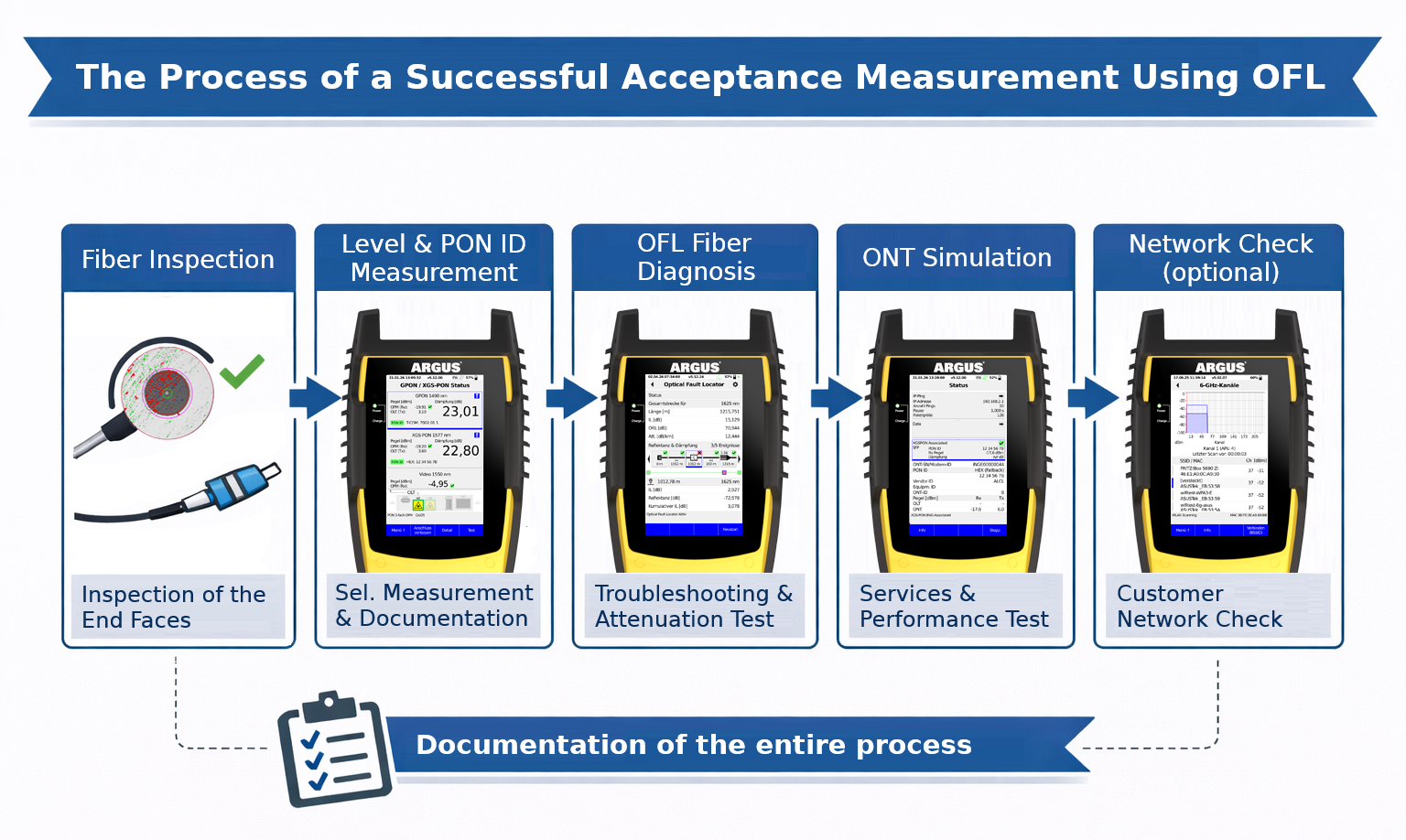
Flowchart of an access acceptance test using an Optical Fault Locator and ARGUS F240. This allows the attenuation of the installed line up to the next splitter to be clearly determined and documented
Test the connection in practice
The key factor is whether the service works under real-world conditions. A comprehensive acceptance test must therefore be conducted at the protocol level and verify the access exactly as it will be used later. This includes simulating a real GPON or XGS-PON ONT with the correct login credentials, serial number, and configuration. It is precisely here that errors arise in practice that remain invisible during pure fiber measurements but often lead to disruptions and impair customer satisfaction. In addition to mere availability, actual performance is crucial.
Simply proving that a connection exists is not enough—the promised performance must also be delivered. That is why speed tests of up to 10 Gbps conducted directly at the access are a key part of the evaluation. This is the only way to clearly determine whether the interplay between infrastructure, configuration, and end devices is working properly.
In addition, typical services must be tested: A VoIP test determines whether voice services are provided with sufficient quality. IPTV services are sensitive to packet loss, jitter, and latency. And it is precisely the increasingly important OTT services that often reveal problems first, because they replicate real-world usage scenarios. Many disruptions do not originate on the fiber-optic cable itself, but at the protocol or configuration level. The access works technically, but services behave erratically, drop out, or fail to deliver the expected quality. Without appropriate testing, such errors often remain undetected until the customer reports them.
Another critical issue is the home network. From the customer’s perspective, access quality is assessed based on the Wi-Fi. While modern standards like WiFi 7 enable high data rates, they also reveal when the access point, router, and end device are not optimally configured to work together. A simple check of the local network can help clearly determine whether the cause of a problem lies with the access or the home network.
Usability and Trust
In addition to measurement technology, usability in the field is a key factor in day-to-day operations. Measurement methods are of little use if they are difficult to understand or reproduce under time pressure. Intuitive operation, straightforward workflows, fast startup times, and consistent presentation of results lower the learning curve and significantly increase acceptance among service technicians.
A commissioning measurement is only reliable if its results are recorded in a complete and traceable manner. Structured reports that can be directly transferred and processed provide a reliable foundation for subsequent operation.
Trust is also a key factor. Origin, serviceability, and data security are playing an increasingly important role. Measurement technology from Europe is often closely aligned with the network architectures in use, offers quick access to support, and ensures long-term development.
The solution must work in the field
Ultimately, it is not the individual measurement function that matters, but the ability to quickly arrive at a clear conclusion in the field. Those who examine the fiber, protocol, and service separately will have to troubleshoot problems later during operation. Those who test everything as part of an end-to-end process can identify issues as early as the acceptance phase. The key factors here are: clear results rather than interpretation, reproducible procedures rather than individual measurements, and comprehensive documentation as the foundation for operation.
Integrated test systems such as the ARGUS® F240 from intec GmbH demonstrate that this approach can already be implemented in practice today—developed and manufactured in Germany. For applications that do not require advanced service testing, the ARGUS® F200 offers a more compact solution.
Download our technical article as a PDF here.
The technical article ist also available in French and Dutch.
back to overview