How can I measure GPON and XGS-PON simultaneously on a single fiber?
GPON and XGS-PON can be transmitted in parallel over the same fiber optic cable because the two technologies use different wavelengths. For technicians, this means that multiple optical signals can be present at a single port at the same time.
To evaluate these correctly, the individual wavelengths must be measured separately. A selective or filtered PON power meter is used for this purpose. It can distinguish between the relevant GPON and XGS-PON wavelengths and measure their optical levels separately.
What wavelengths do GPON and XGS-PON use?
GPON and XGS-PON use different wavelengths for downstream and upstream traffic:
| Technology | Downstream | Upstream |
|---|---|---|
| GPON | 1490 nm | 1310 nm |
| XGS-PON | 1577 nm | 1270 nm |
This can lead to mixed operation—in which both technologies are transmitted simultaneously over the same fiber—particularly during the gradual upgrade of existing GPON networks to XGS-PON.
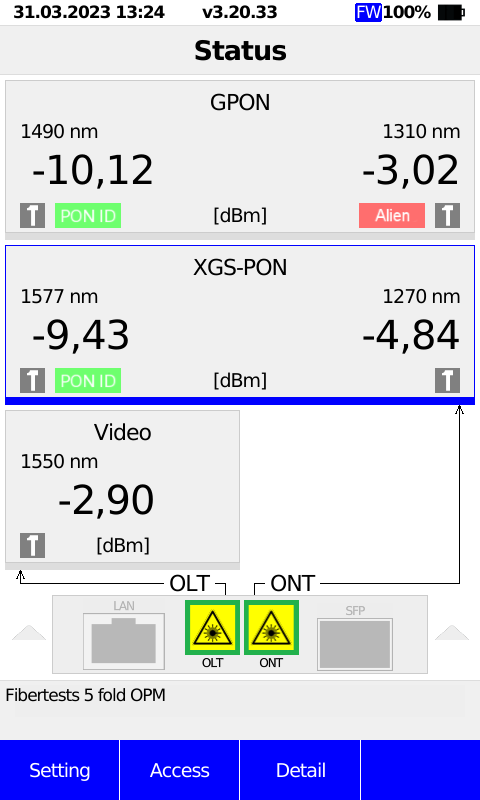
Selective Level Measurement for GPON and XGS-PON: The different downstream and upstream wavelengths are measured and displayed separately.
Why isn't a simple power meter enough?
A simple broadband power meter measures optical power, but it cannot specifically distinguish between the PON wavelengths that are present simultaneously.
A plausible total value therefore does not automatically mean that both the GPON and XGS-PON levels are within the specified range.
A selective or filtered PON power meter, on the other hand, separates the relevant wavelengths and allows for their individual measurement and evaluation. This makes it possible, for example, to distinguish which level corresponds to the GPON signal and which to the XGS-PON signal.
What is “Through Mode” in a PON measurement?
The measurement is even more informative in Through Mode. In this mode, the tester is connected between the PON and the ONT. The connection remains active while the optical signals between the OLT and the ONT are measured.
This allows downstream and upstream signals to be analyzed while the PON is in operation.
This is particularly relevant for the upstream: While the OLT transmits continuously in the downstream, the individual ONTs in the upstream transmit only within their assigned time slots. The PON power meter must therefore also be able to detect these burst-like upstream signals.
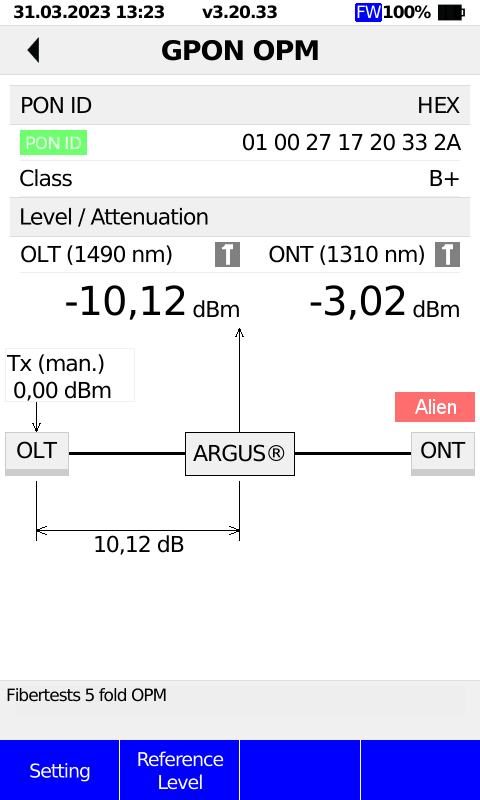
Through Mode: Downstream and upstream levels for GPON and XGS-PON are measured separately while the PON is in operation.
How does simultaneous measurement of GPON and XGS-PON work?
In simple terms, the measurement procedure is as follows:
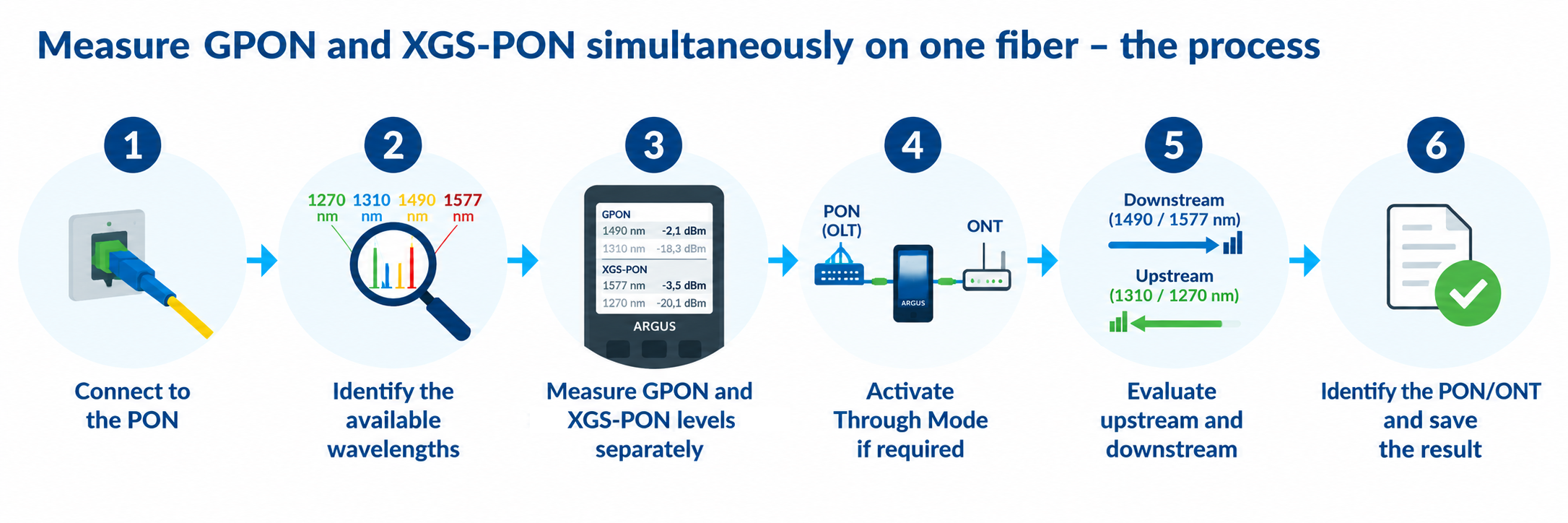
Connect the PON → Identify the available wavelengths → Measure GPON and XGS-PON levels separately → Use Through Mode if necessary → Evaluate upstream and downstream → Identify the PON/ONT
This not only provides the technician with information that an optical signal is present, but also allows him or her to evaluate the various PON signals separately.
Which ARGUS testers can measure GPON and XGS-PON?
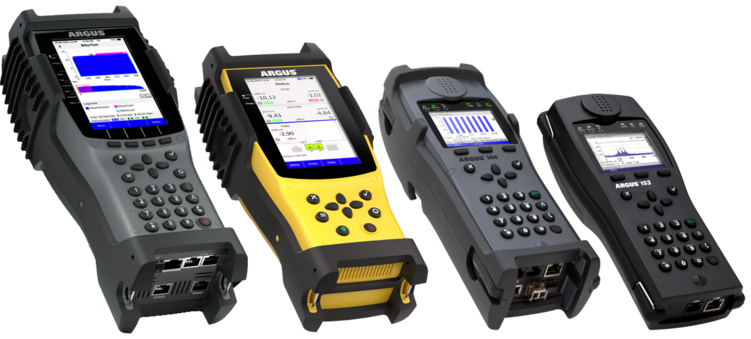
For parallel measurement of GPON and XGS-PON, the ARGUS® F200, ARGUS® F240, and ARGUS® F300 offer selective PON measurement functions, depending on the specific configuration.
The selective power meter can be connected to an existing PON connection in Through Mode to measure the optical levels of the various downstream and upstream wavelengths. In addition, depending on the configuration, the meter can determine other PON information, such as the PON ID, and detect alien ONTs on the line.

on the road

We are at the Breitbandforum Mecklenburg-Vorpommern:
05 November 2026
in Rostock-Warnemünde
Booth S17

Visit us at the Fiberdays27:
17 - 18 February 2027
in Frankfurt am Main

Visit us at ANGA COM:
01 - 03 June 2027
in Cologne