How can I test a GPON or XGS-PON access if the ONT isn't registering?
If an ONT does not register with the OLT, this does not automatically mean that the ONT is defective. The cause can lie at various levels: in the fiber optic cable and the optical signal level, in the assignment to the correct PON, in the ONT authentication, or in the network configuration.
Systematic troubleshooting therefore begins at the physical level and then progresses to the registration and IP connection.
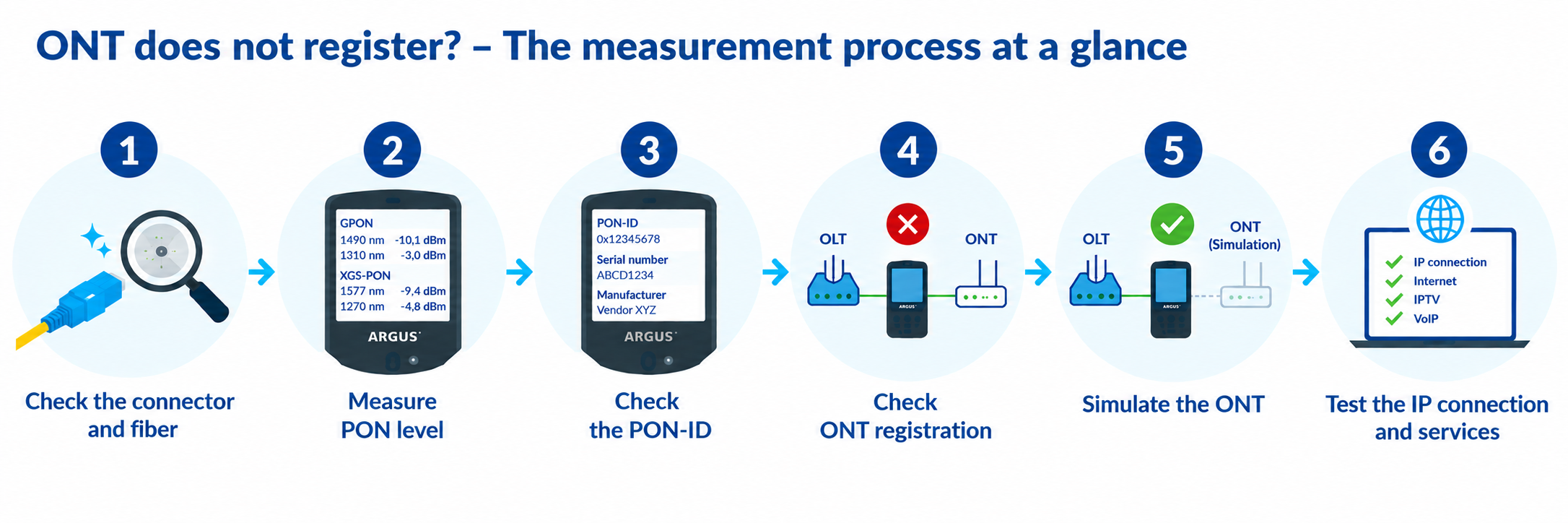
Check connectors/fibers → Measure PON level → Verify PON ID → Check ONT registration → Simulate ONT → Test IP connection and services
Is the optical PON level sufficient?
A selective or filtered PON power meter can measure the relevant GPON and XGS-PON wavelengths separately. This makes it possible to determine whether the respective optical signal is present at the access and what its level is.
If the level is abnormal, the optical path should be examined further first. If, on the other hand, the optical path appears normal, troubleshooting can continue at the next level.
Am I at the right PON?
A sufficient optical level alone does not mean that the connection has been assigned to the intended PON branch.
The PON-ID can be used to verify the assignment to the PON. This allows for the early detection of incorrect fiber or port assignments, particularly in installations with many fibers or central distribution points.
Why isn't the ONT registering?
If the fiber, signal level, and PON assignment are normal, the registration itself can be examined.
Possible causes could include, for example, authentication, configuration, or activation of the access. At this point, it is helpful to distinguish the customer's ONT as a potential source of error from the network side.
How does an ONT simulation help with troubleshooting?
In an ONT simulation, the tester assumes the role of the ONT and attempts to establish a connection with the OLT on its own. This allows you to verify whether the connection can be established independently of the customer's existing ONT.
If the tester registers successfully, this indicates that the optical link and the network side are functioning properly and that the cause may lie with the customer's ONT or its configuration.
If the ONT simulation also fails, troubleshooting can be focused on authentication, OLT configuration, or network activation.
Are the IP connection and services working?
A successful ONT registration does not automatically mean that the access is fully functional. Therefore, once the connection is established, tests at higher protocol levels may follow.
Depending on the specific use case, the following functions can be checked:
- IP connection
- Up- and download
- Ping
- Internet access
- IPTV
- VoIP
This allows the diagnostic process to continue from the physical fiber-optic connection through PON registration to the actual services.
How do ARGUS testers assist with PON troubleshooting?
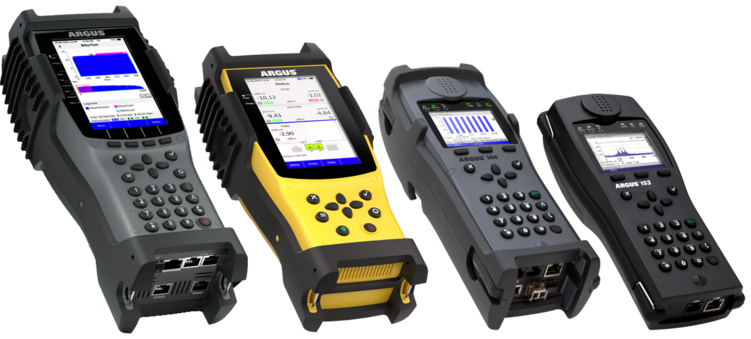
Using the appropriate ARGUS measurement functions, several steps of PON diagnostics can be combined in a single tester: fiber inspection, selective level measurement, PON ID, ONT simulation, and IP and performance tests.
This allows the technician to narrow down the cause of the error step by step, rather than simply stating:
“The ONT isn’t registering.”
The crucial question is rather:
Is the cause in the fiber-optic link, the PON configuration, the ONT, or on the network side?

on the road

We are at the Breitbandforum Mecklenburg-Vorpommern:
05 November 2026
in Rostock-Warnemünde
Booth S17

Visit us at the Fiberdays27:
17 - 18 February 2027
in Frankfurt am Main

Visit us at ANGA COM:
01 - 03 June 2027
in Cologne